ASE - Electrical Engineering - MHEC Outcomes
Electrical Engineering Outcomes
Outcomes for Physics for Electrical Engineering
Ouctomes for Chemistry for Electrical Engineering
Outcomes for Mathematics for Electrical Engineering
Electrical Engineering Outcomes
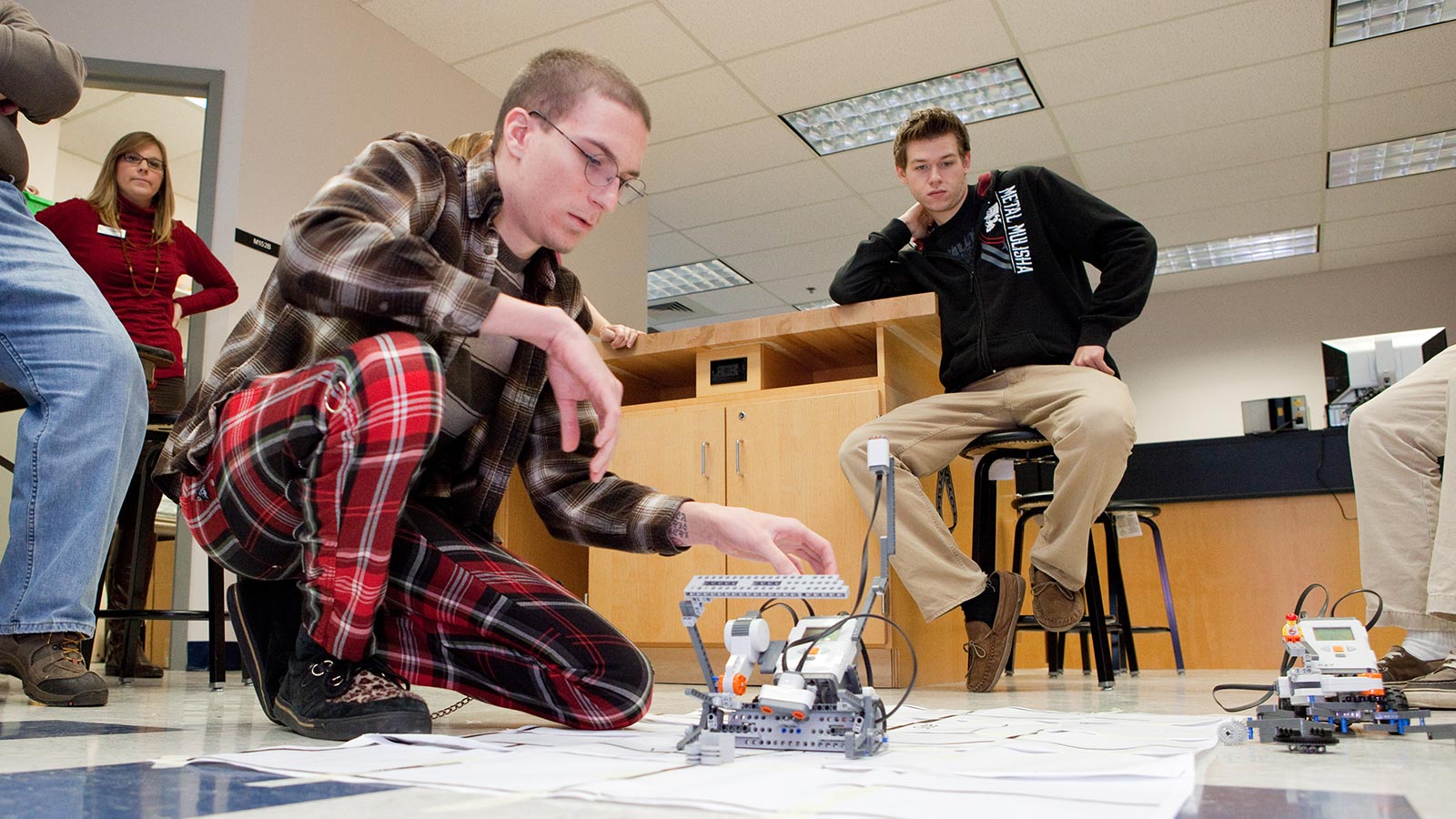
- Understand and engage in the engineering project development process. This includes: problem specification, design, modeling, simulation/CAE (computer aided engineering), fabrication, testing and redesign.
- Understand the mechanics of group dynamics and demonstrate the ability to contribute to a team.
ENGR 100 - Introduction to Engineering
ENEE 206 - Electrical and Digital Circuit Lab
PHYS 111 - Physics 1 for Scientists & Engineers
PHYS 212 - Physics 2 for Scientists & Engineers
PHYS 213 - Physics 3 for Scientists & Engineers - Demonstrate effective oral and written communication skills.
ENGL 101 - College Writing 1
ENGR 100 - Introduction to Engineering - Understand the role of ethics in the engineering discipline.
- Use simulation tools to design circuits and analyze performance.
ENEE 204 - Electric Circuit Theory
ENEE 206 - Electrical and Digital Circuit Lab
ENEE 244 - Digital Logic Design - Effectively design, build and test circuits with current ICs, resistors, inductors, capacitors, diodes, and operational amplifiers.
ENEE 204 - Electric Circuit Theory
ENEE 206 - Electrical and Digital Circuit Lab - Understand basic operation, limitations and inaccuracies of basic test and measurement equipment. This includes: function generators, DMMs, analog and digital oscilloscopes and Digital Logic Analyzers.
ENEE 206 - Electrical and Digital Circuit Lab
PHYS 212 - Physics 2 for Scientists & Engineers - Demonstrate the ability to analyze experimental data. This includes: using statistical and other methods to qualitatively and quantitatively compare designs and results.
- Know the relations between basic electrical quantities and be able to generate all equations needed to solve any general electric circuit.
ENEE 204 - Electric Circuit Theory
PHYS 212 - Physics 2 for Scientists & Engineers - Use basic circuit techniques in the analysis of AC/DC circuits. This includes: Nodal and Mesh analysis, voltage and current divider rules, superposition, and Thevenin and Norton equivalents.
- Calculate transient circuit responses for first and second order circuits.
- Understand how to generate transfer functions for circuits with one source and how to use transfer functions to solve general transient problems.
- Understand elementary operation of electronic circuits with ideal operational amplifiers and dependent sources.
ENEE 204 - Electric Circuit Theory
ENEE 206 - Electrical and Digital Circuit Lab - Design and analyze combinational logic circuits.
- Design and analyze synchronous sequential circuits.
- Become proficient in a numerical analysis application, such as MATLAB or Octave.
- Become familiar with different aspects of numerical computation and some of its limitations.
- Master basic tools from linear algebra for computational use. Formulate and solve matrix equations. Be familiar with eigenvalues and their applications.
- Understanding of the basic concepts of signals and linear systems, LaPlace Transforms; development and application of FFTs.
- Understand the programming and software development flow and write programs in a high-level programming language (like C, C++).
Outcomes for Physics for Electrical Engineering
Content Knowledge: The student will know and apply the concepts and laws of physics (at the level of standard calculus-based physics textbooks, see note below) to understand and explain the behavior of the physical world.
Examples of standard calculus-based introductory-level physics textbooks (including modern physics) are:
- "Fundamentals of Physics" by Halliday, Resnick & Walker
- "Physics for Scientists and Engineers" by Serway & Beichner
- "Physics for Scientists and Engineers" by Tipler & Mosca
- "Physics for Scientists and Engineers" with Modern Physics by Giancoli
- "University Physics" by Young & Freedman
- "University Physics" by Reese
- "Understanding Physics" by the Physics Education Group
Mechanics: vectors and scalars; kinematics; statics and dynamics; work and energy; energy and momentum conservation laws; simple harmonic motion; rotational dynamics; gravitational fields; fluid mechanics
PHYS 111 - Physics 1 for Scientists & Engineers
Magnetism: static electricity; electric forces, potentials, and fields; electrical and magnetic properties of materials; AC and DC circuits and circuit components; magnetic forces and fields; electromagnetic induction; electromagnetic radiation; Maxwell's equations
PHYS 212 - Physics 2 for Scientists & Engineers
Heat and Thermodynamics: temperature, heat, heat capacity and heat transfer; kinetic molecular theory; phase changes; laws of thermodynamics with applications such as heat engines
PHYS 212 - Physics 2 for Scientists & Engineers
Optics and Waves: transverse and longitudinal waves and their properties and characteristics; refraction, reflection, and superposition of waves; applications to light and sound; geometric and physical optics
PHYS 213 - Physics 3 for Scientists & Engineers
Modern Physics: atomic models and their experimental bases; structure of the atoms and molecules; nuclear reactions and radioactivity; special relativity; photoelectric effect; wave-particle duality; introduction to quantum mechanics
PHYS 213 - Physics 3 for Scientists & Engineers
PHYS 111 - Physics 1 for Scientists & Engineers, PHYS 212 - Physics 2 for Scientists & Engineers and PHYS 213 – Physics 3 for Scientists & Engineers apply to the following outcomes.
- Students will know the vocabulary and mathematical language associated with each content knowledge area listed above.
- Students will understand the concepts, relationships, and principles of each content area listed above and the interrelationships between related content areas.
- Students will apply concepts and relationships to qualitative problems and quantitative problems in each content knowledge area listed above.
- Students will investigate a classical physical system experimentally (in at least each of the broad content knowledge areas listed above).
- Students will work individually and cooperatively in teams on investigations and/or problem solutions.
Ouctomes for Chemistry for Electrical Engineering
CHEM 105 – Principles of General Chemistry 1 applies to the following 15 outcomes.
- Make measurements and express those measurements in common and metric units; manipulate units.
- Identify and apply significant figures and exponential notation to measurement.
- Describe nature of science and scientific investigation.
- Distinguish among states of matter; explain behaviors of states based on particulate nature.
- Identify basic atomic structure; describe historical development of atomic theory and its relationship to spectroscopy.
- Explain principles of the quantum mechanical model of the atom.
- Outline the development of and trends conveyed by the periodic table of the elements.
- Define the concept of bonding as resulting from electron interactions; understand bond nature as a continuum.
- Visualize geometries of molecules; apply VSEPR theory and hybridization theory.
- Identify chemical nomenclature.
- Define the mole concept and stoichiometry.
- Identify physical and chemical properties of acids and bases.
- Describe interactions of matter and energy.
- Compare concept of heat exchange in physical and chemical systems.
- Understand safe laboratory practice.
Outcomes for Mathematics for Electrical Engineering
- Calculate the limits of functions.
MATH 135 - Calculus of a Single Variable 1
MATH 136 - Calculus of a Single Variable 2 - Analyze continuity of a function.
MATH 135 - Calculus of a Single Variable 1
MATH 136 - Calculus of a Single Variable 2 - Find the derivatives of functions numerically, algebraically, and graphically.
MATH 135 - Calculus of a Single Variable 1
MATH 136 - Calculus of a Single Variable 2 - Apply the derivative to a wide range of problems.
MATH 135 - Calculus of a Single Variable 1
MATH 136 - Calculus of a Single Variable 2 - Calculate definite and improper integrals; find indefinite integrals.
MATH 135 - Calculus of a Single Variable 1
MATH 136 - Calculus of a Single Variable 2 - Solve a wide range of problems related to integration.
MATH 135 - Calculus of a Single Variable 1
MATH 136 - Calculus of a Single Variable 2 - Identify the basic properties of functions.
MATH 135 - Calculus of a Single Variable 1
MATH 136 - Calculus of a Single Variable 2 - Analyze the convergence or divergence of sequences and series.
- Graph and analyze polar equations, parametric equations, and conic sections.
- Solve elementary differential equations.
MATH 135 - Calculus of a Single Variable 1
MATH 136 - Calculus of a Single Variable 2
MATH 215 - Differential Equations - Explain properties of vectors and vector-valued functions.
- Apply differentiation rules, including the Chain Rule, to various multivariable functions. Identify these properties of quadric surfaces.
- Evaluate multiple integrals.
- Explain properties of vector fields and evaluate various vector field derivatives and integrals.
- Classify and solve first order, ordinary differential equations (ODE).
- Use numerical tools to solve basic differential equations.
- Classify and solve second order, ordinary differential equations.
- Calculate Laplace transforms and apply to basic differential equations.
- Solve basic systems of first order linear differential equations.