Welder/Advanced Welder Certificate
At a Glance
Spark Up Your Welding Career with Hands-On Training
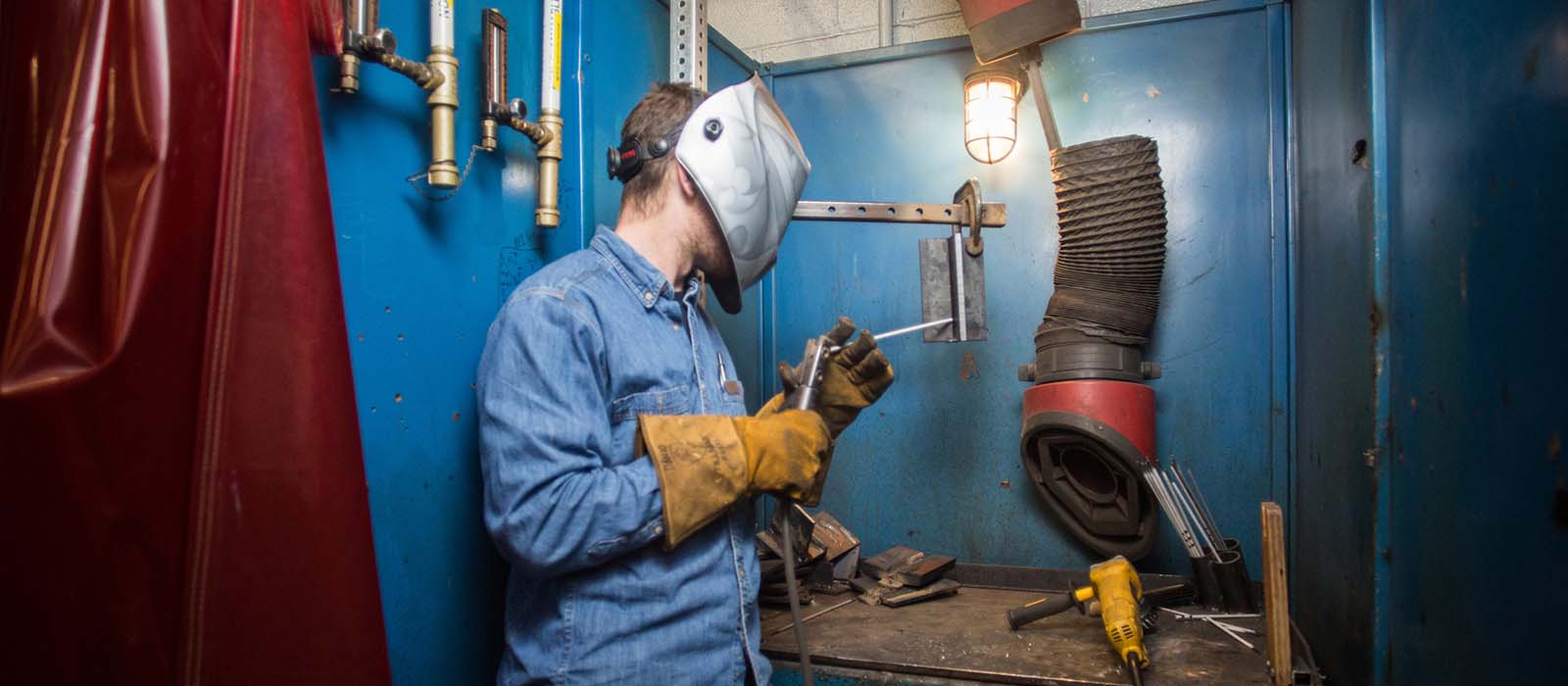
In our Welding certificate training program, you will learn a variety of welding techniques on our Augmented Reality (AR) welders, then put them into practice with plenty of hands-on training in a welding lab.
Schedule:
Courses offered Fall & Spring; weekday evening classes
Next Start Date:
Sept. 9, 2026
Approx. Number of Hours/Months:
120 hours/6 months
Program Cost:*
$3,173 (includes certification exam); up to 100% may be covered by the Ratcliffe Works Grant: Apply for Assistance
Certification Earned:
AWS D1.1 Structural Steel
What You’ll Learn
You will be trained in a wide variety of welding techniques, including:
- Styles: MIG, Flux-Cored, Stick, TIG
- Types: Bead on Plate, T-Joint, Lap Joint, Butt Joint
- Positions: Horizontal, Vertical, Flat
- Material: Steel, Stainless, Aluminum with TIG
You will also learn how to read blueprints, interpret symbols, and follow specifications to fuse different metal components together.
Curriculum
Training takes place at the Carroll County Career and Technology Center in Westminster.
For all classes, you must wear protective gear/clothing and follow specific protocols to maintain a safe working environment.
View all current course offerings. Not all courses are offered within every term schedule.
Welding I provides a foundational introduction to gas and arc welding for beginning welders looking to get into the industry. Students learn the safe and proper handling of welding equipment, including oxy-acetylene and arc welding systems. Instruction covers welding safety practices, electrode and filler metal selection, metal cutting techniques, and the fundamentals of arc, MIG (GMAW), and TIG (GTAW) welding processes. Students gain hands-on experience operating welding equipment in a controlled lab environment. For safety reasons, students must wear long-sleeve shirts, long pants, and hard shoes. Course cost includes a welding helmet, required personal protective equipment, and basic tools.
Welding II builds on the skills and knowledge developed in Welding I, with increased emphasis on technique refinement, positional welding, and career readiness. Students gain additional hands-on experience safely operating oxy-acetylene, MIG (GMAW), TIG (GTAW), and arc welding equipment. Instruction focuses on developing consistent weld quality while welding in multiple positions, including flat and vertical orientations. Students continue to strengthen processselection skills and apply industry-standard practices in preparation for advanced training and American Welding Society (AWS) certification pathways. For safety reasons, students must wear long-sleeve shirts, long pants, and hard shoes. Course cost includes additional required personal protective equipment and basic tools.
Prerequisite: Welding I or equivalent experience.
Licensure/Certification Earned
Upon successful completion of both courses, students will be prepared to take the AWS D1.1 Structural Welding Certification.
This can be taken in the Welding Certification Prep Course (VOC-155). This course is not part of the Welding Workforce Certificate Program.
Welders can earn additional certifications to enhance their skillset and increase their employment opportunities.
Get Paid to Prepare for This In-Demand Career
Since completing Carroll’s program, I am now working as a welder in the field. Everyday I am reminded that this is what I was meant to do.
Why Choose Carroll’s Welding Training?
- Real-World Experience: Learn from instructors with years of industry experience.
- State-of-the-Market Equipment: Train on Augmented Reality (AR) welders and in a fully equipped welding lab.
- Affordable: Up to 100% of the program cost may be covered by the Ratcliffe Works grant for eligible participants.
- Industry-Aligned Curriculum: Our program is shaped by local business leaders and industry experts, ensuring you learn the skills employers are looking for right now. View our Advisory Boards.
Career Outlook
Welders are employed in all phases of industrial operations across a wide range of industries, including construction, manufacturing, and infrastructure. This broad applicability means welding skills remain in demand across the country.
The U.S. Bureau of Labor Statistics (BLS) projects a modest 2% growth in employment for welders, cutters, solderers, and brazers between 2023 and 2033, with the industry expecting to see approximately 45,800 job openings each year. These openings are largely due to retirements and workforce turnover, signaling strong replacement demand and long-term job stability.
A significant driver of continued demand is the need to maintain and repair aging infrastructure. Roads, bridges, utility systems, and public works projects require skilled welders to ensure safety and reliability. At the same time, manufacturing sectors—particularly automotive, aerospace, energy, and construction—continue to rely heavily on welding professionals to fabricate and assemble parts, machinery, and large-scale structures.
Welding remains a reliable and rewarding career path for those who enjoy hands-on work and want to enter a high-demand field. With opportunities to grow, earn competitive wages, and contribute to critical projects across industries, trained welders are essential to America’s industrial future.
- What is AWS D1.1?
AWS D1.1 is a widely recognized structural welding code established by the American Welding Society (AWS). It sets quality and performance standards for welding structural steel and is commonly required for welders working in construction, manufacturing, and infrastructure projects. Welders who pass an AWS D1.1 performance qualification test demonstrate their ability to produce welds that meet industry standards. - What types of welding certifications can I earn in Maryland through this program?
Carroll’s program prepares students for the AWS D1.1 Structural Steel performance qualification, a nationally recognized credential issued in accordance with American Welding Society (AWS) standards. This qualification is widely accepted by employers in industries such as construction, manufacturing, fabrication, and shipbuilding. - What is the difference between the Welder I and Welder II Certificates at Carroll?
The Welder I and Welder II Certificates are stackable, allowing students to progress from foundational skills to advanced certification preparation.- Welder I Certificate (VOC-153 – Welding I)
- Introduces welding safety, equipment, and basic techniques
- Covers MIG, TIG, stick, and oxy-acetylene welding
- Focuses on foundational skills and proper welding practices
- Welder II Certificate (VOC-154 – Welding II)
- Builds on basic skills with more complex welds and techniques
- Emphasizes flat and vertical welds and precision work
- Provides extensive hands-on practice with MIG, TIG, and stick welding
- Prepares students for the AWS D1.1 weld test, which can be taken in the optional Welding Certification Prep course (VOC-155).
Completion of the Welding I course is required before enrolling in Welding II.
- Welder I Certificate (VOC-153 – Welding I)
- How long does the welding program take to complete?
The full Welder Certificate sequence includes approximately 120 hours of instruction. Depending on course availability and student scheduling, the program can be completed in 6 months to 1 year. Courses are offered in the Fall and Spring and are designed to accommodate working adults. - Is hands-on welding experience included in the curriculum?
Yes. The program emphasizes hands-on training and includes:- Live welding labs that simulate real-world work environments
- Instruction using MIG, TIG, stick, and flux-cored welding equipment
- Are there prerequisites for this program?
No prior welding experience is required. The program is open to students of all skill levels, including beginners with no previous welding background. - Do I need to bring my own equipment?
No. All required welding equipment is provided, including auto-darkening helmets and safety gear used during training. - Do I have to learn a specific style?
No. The Welding I course introduces students to multiple welding processes. In the Welding II course, students have the opportunity to focus on specific welding styles and techniques aligned with their career interests and certification goals. - Does welding take a lot of math?
Welding requires basic math and measurement skills, including:- Measuring and converting units
- Understanding angles and basic geometry
- Reading blueprints and welding specifications
- Interpreting gauges and gas mixture settings
While advanced math is not required, comfort with numbers and spatial reasoning is important for accuracy, quality, and safety.
- Is financial assistance available?
Yes! Through Ratcliffe Works and other programs, you may qualify to have up to 100% of the cost of the program covered. Check your eligibility today.
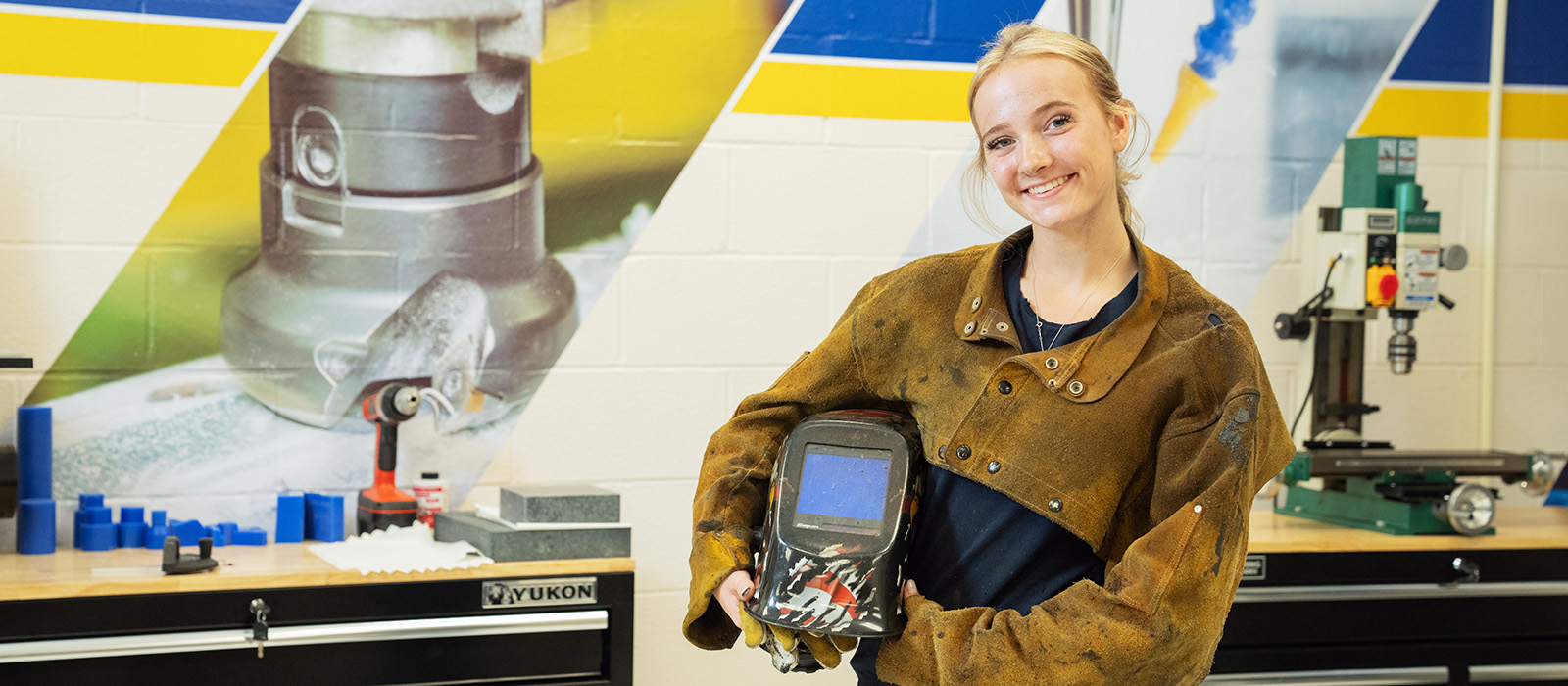
Grace Meets Grit: Carroll Student’s Path from Dance Studio to Welding Program
Read More about Grace Meets Grit: Carroll Student’s Path from Dance Studio to Welding ProgramGet Started Today
410-386-8100 | wbce@carrollcc.edu | Building A, Room 115
*Unless noted, cost does not include any required textbooks and related materials, applicable licensing fees, background check fees, testing fees or prerequisite courses.