Center For Teaching & Learning
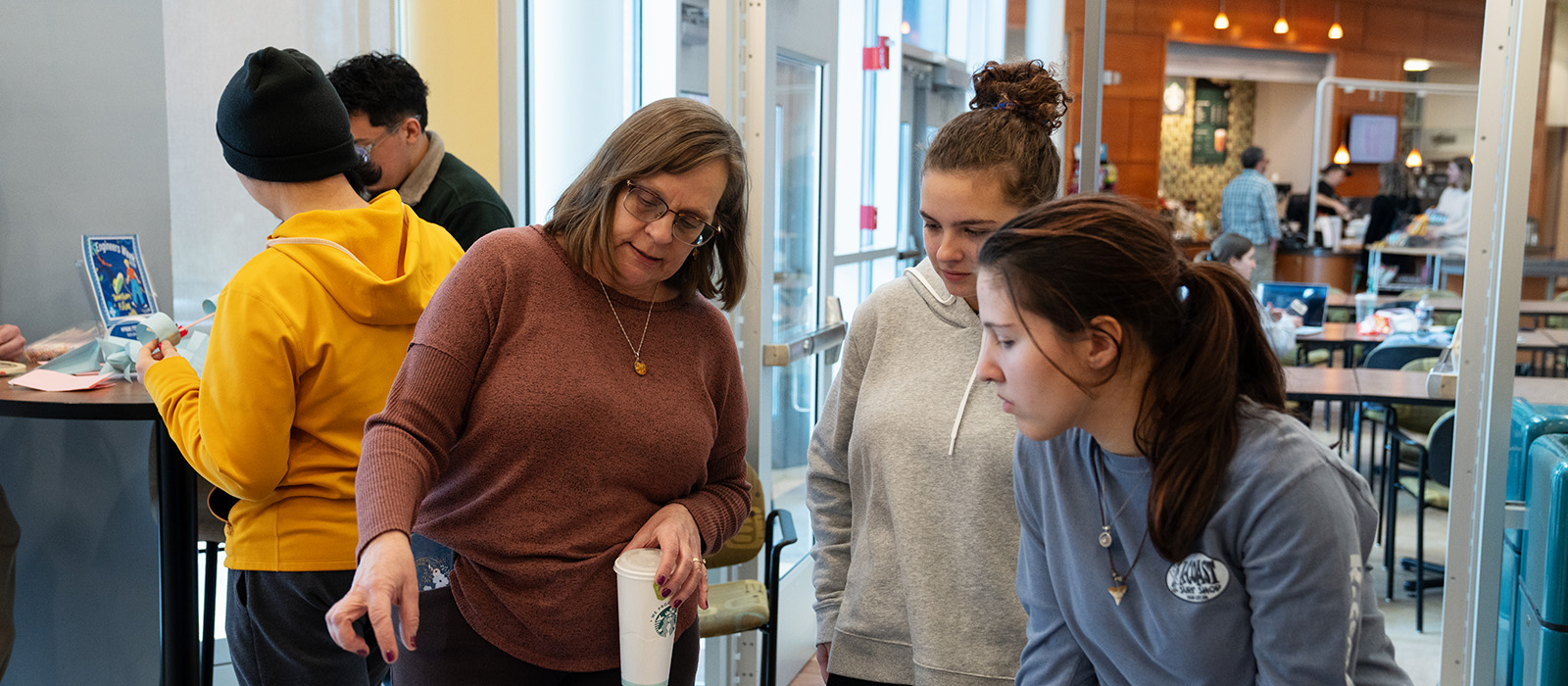
As an institution of higher education, Carroll Community College’s Center for Teaching and Learning (CTL) advances best practices by catalyzing innovation, growth, transformation, and success.
Areas of Focus
Teaching
Teaching is essential to the College’s mission for Empowering Learners. Changes Lives. Building Community. Employees are trained in the following areas:
As presented on our Digital Accessibility Statement webpage, employees are trained to meet or exceed the requirements of WCAG 2.0 Level AA for all digital resources, including:
- Instructional content
- Administrative content
- Communications content
Faculty and staff participate in accessibility training. If instructors are required to use Canvas, accessibility training specific to the platform is provided to ensure documents, media, and other instructional materials meet the requirements.
Canvas is our Learning Management System (LMS). It is the principal vehicle for delivering digital course materials, grades, and user communication online.
All faculty using the Canvas LMS participate in training to use the various features available and are eligible to participate in any professional development related to new, approved tools that integrate into Canvas.
Starfish is a comprehensive student success platform designed to improve student retention, academic program, and institutional coordination and communication. Faculty are trained to use Starfish to send positive feedback, progress reports, and student support alerts as needed.
Faculty, staff, and students are provided with free access to all Microsoft Office products, including Word, Excel, PowerPoint, Outlook, and many others. Faculty receive training on how to use Outlook for email communication, calendar features, and Microsoft Teams
Learning
Learning is measured and fostered through multiple methods at Carroll:
Our course-level assessment approach focuses on aligning assignments and course activities to measure students’ achievement of learning outcomes. Faculty follow these steps when conducting course-level assessment:
- Identify the course learning outcome.
Determine exactly what students should know or be able to do. - Align the assessment.
Select an assignment, exam component, performance, project, clinical experience, presentation, or other artifact that demonstrates the outcome. - Establish criteria for success.
Use a rubric, scoring guide, benchmark, or other defined criteria. - Assess student work.
Faculty evaluate an appropriate sample or cohort of student artifacts. - Analyze the findings.
Look beyond percentages. Faculty should ask where students are succeeding, where they are struggling, and whether patterns suggest curricular or instructional issues. - Act on the evidence and reassess.
Faculty may change an assignment, instructional strategy, prerequisite, course sequence, learning activity, or curriculum and then examine whether student achievement improves.
Carroll’s general education assessment processes emphasize essentials skills achievement in alignment with our Learn and Experience strategic plan pillars. Each general education course has a specific assignment designed to measure Learn and Experience skills that are developed in a course.
Learn Pillar
- Communicate effectively.
- Written Communication: Constructs a message that aligns with an audience, context, and purpose using appropriate conventions.
- Oral Communication: Delivers a message intentionally tailored to an audience, context, and purpose.
- Creative Expression: Produces a work or performance with intentional design and impact.
- Think deliberately and originally.
- Critical Thinking: Applies evidence-based reasoning to analyze or solve problems.
- Creative Thinking: Explores novel ideas or approaches to generate solutions or insights.
- Quantitative Reasoning: Uses numerical data to support judgments and conclusions.
- Scientific Reasoning: Applies a systematic process to evaluate evidence and test hypotheses.
- Problem Solving: Selects and implements practical strategies to address challenges.
- Use information and technology.
- Information Literacy: Integrates verifiable and credible sources with proper attribution.
- Technological Literacy: Uses appropriate digital tools or platforms to complete academic tasks. (Examples: Word, Excel, graphing calculator, educational websites, library databases, artificial intelligence, etc., as instructed in the assignment.)
Experience Pillar
- Analyze human experiences.
- Self-Awareness: Demonstrates insight into personal values or experiences and connects them to broader human contexts or perspectives.
- Cultural Comprehension: Interprets cultural practices or phenomena with awareness of personal and societal perspectives.
- Ethical Reasoning: Evaluates ethical dimensions of issues or decisions using multiple viewpoints.
- Global Awareness: Explores historical and contemporary human actions and their global impact.
- Engage in and reflect on learning experiences.
- Collaboration: Demonstrates effective teamwork behaviors and contributions with reflection.
- Experiential Reflection: Reflects on in-class or out-of-class experiences with insight and connection to learning.
- Explore practices for well-being.
- Career Exploration: Investigates career options and outlines next steps toward professional goals.
- Wellness Literacy: Applies principles of well-being (e.g., financial, emotional, physical) to personal decision-making.
Scoring teams comprised of faculty and staff evaluate a representative sample of assignments to assess General Education outcomes . Results drive continuous improvement of the General Education curriculum and faculty development
Program assessment determines whether students in their declared associate degree, certificate, or workforce programs have achieved the program’s goals which are designed for student success after transfer or employment.
Our program directors and coordinators design assignments, exams, and specific program course activities to measure student achievement of program goals in designated semesters each academic year. Program goals are assessed twice within a four-year cycle. Improvements are implemented as needed and goals are reassessed for the second assessment. The overall results within the four-year period are used to write a five-year program review report.
Internships, service learning, and other learning activities, such as field trips, guest speakers, special events, and the Real-World Ready Mentorship program connect students to experiences beyond the classroom.
Faculty may embed and assess experiential learning in course assignments and projects to foster content and skill application.
The Student Excellence Showcase is an annual celebration of student learning.
Professional Growth System
Through its professional growth system, Carroll Community College provides various methods for employees to advance their knowledge, skills, and abilities. These methods include:
- Workshops
- Microcredentials
- Professional learning communities
- Promotion portfolios and projects
- Special Projects
Redesign Academy
The Redesign Academy is a developing initiative to transform course and training delivery lengths and modalities to meet students’ needs while maintaining rigor and quality. The Redesign Academy will focus on the following areas:
- Accelerated courses (7-weeks)
- Hyflex delivery
- Online course improvements
Applied Educational Research Collaborative
The Applied Educational Research Collaborative is a developing opportunity to make recommendations for solving site-specific problems and improving practices through multimethod approaches and mobilizing faculty, staff, and students to conduct practical research. The Applied Educational Research Collaboration will focus on two areas:
- Internal research
- External research
Note for Employees
This content is available on our secure SharePoint site. You must be logged in with your Carroll Community College account to access the page.