Test Page for New Widgets
ParagraphParagraphParagraphParagraphParagraphParagraphParagraph ParagraphParagraphParagraphParagraphParagraphParagraph ParagraphParagraphParagraphParagraphParagraphParagraphParagraphParagraphParagraphParagraphParag raphParagraphParagraphParagraphParagraphParagraphParagraphParagraphParagraphParagraphParagra phParagraphParagraphParagraphParagraphParagraphParagr aphParagraphParagraphParagraphParagraphParagraphParagraphParagraphParagraph

Teaching
Text about teaching
- Accessibility
- Canvas
- Starfish
- Microsoft/Copilot 365
Learning
texttexttexttexttexttexttexttexttexttexttexttexttexttexttex ttexttexttexttexttexttexttexttexttexttexttexttexttexttexttex ttexttexttexttexttexttexttexttexttexttexttexttexttexttexttexttexttexttexttexttexttexttexttexttexttex ttexttexttexttexttexttexttexttexttexttexttexttexttexttexttexttexttexttexttexttexttext
- Accessibility
- Canvas
- Starfish
- Microsoft/Copilot 365

Learning
texttexttexttexttexttexttexttexttexttexttexttexttexttexttex ttexttexttexttexttexttexttexttexttextte xttexttexttexttexttex ttexttexttexttexttexttexttexttexttexttexttexttexttextt exttexttexttexttexttexttexttexttexttexttexttex ttexttexttexttexttexttexttexttexttexttexttexttexttexttexttexttexttexttexttexttexttext
- Learning outcomes assessment which includes course level, program level, and general education essential skills assessment, informs student success.
- Internships, service learning, experiential learning activities (field trips, guest speakers, events), and the Real-World Ready Mentorship program connect students to area professionals to further apply course knowledge and skills.
- The Student Excellence Showcase is an annual celebration of student learning.
Teaching
text text text text text text text text text text text text text text text text text text text
- Learning outcomes assessment which includes course level, program level, and general education essential skills assessment, informs student success.
- Internships, service learning, experiential learning activities (field trips, guest speakers, events), and the Real-World Ready Mentorship program connect students to area professionals to further apply course knowledge and skills.
- The Student Excellence Showcase is an annual celebration of student learning.
Download the Student Guide to Due Process (PDF)
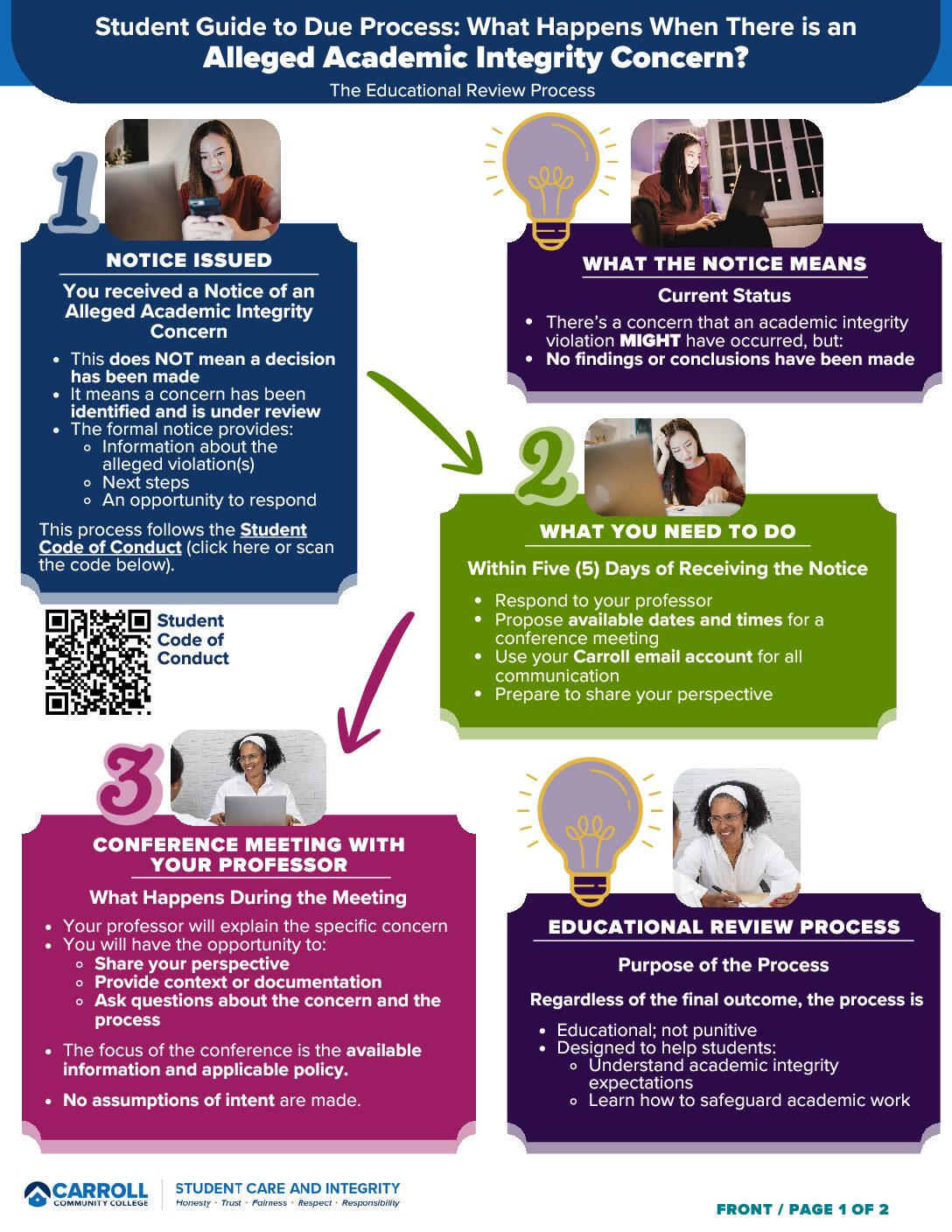
Student Guide to Due Process: What Happens When There Is an Alleged Academic Integrity Concern?
- Notice issued
- You received a Notice of an Alleged Academic Integrity Concern
- This does not mean a decision has been made
- It means a concern has been identified and is under review
- The formal notice provides:
- Information about the alleged violation(s)
- Next steps
- An opportunity to respond
- This process follows the Student Code of Conduct
- There is a concern that an academic integrity violation might have occurred,
but no findings or conclusions have been made
- What you need to do within five days of receiving the notice
- Respond to your professor
- Propose available dates and times for a conference meeting
- Use your Carroll email account for all communication
- Prepare to share your perspective
- Conference meeting with your professor: What happens during the meeting
- Your professor will explain the specific concern
- You will have the opportunity to:
- Share your perspective
- Provide context or documentation
- Ask questions about the concern and the process
- The focus of the conference is the available information and applicable policy
- No assumptions of intent are made
- Purpose of the Educational Review Process:
Regardless of the final outcome, it is:- Educational; not punitive
- Designed to help students:
- Understand academic integrity expectations
- Learn how to safeguard academic work
- Decision and communication after review
- You will receive clear communication regarding:
- Any determination
- Outcomes of the review
- If a student is found responsible, outcomes depend on whether the violation
is a 1st, 2nd, or 3rd violation - Examples of outcomes may include:
- Revision of an assignment within a specified time
- A grade of 0 on an assignment or exam
- Retaking an exam, possibly with a grade reduction
- Taking an online or in-person proctored exam
- Your Academic Integrity Module assignment, if applicable
- Next steps, if applicable
- You will receive clear communication regarding:
- Appeal option (if applicable)If it is determined that you are responsible for the alleged violation and you
disagree, you may appeal on the following limited grounds:- Substantial Procedural Error — A significant mistake in
applying College procedures or policy that resulted in an unfair process - Disproportionate Sanction — The outcome is substantially more
severe than reasonable given the violation - New Evidence — Significant information not reasonably
available during the original review that would have impacted the decision
- Substantial Procedural Error — A significant mistake in
- Ask questions
- Share relevant information or context
- Receive clear, timely communication
You are also expected to:
- Maintain your professionalism
- Address your stress management ahead of time so you can communicate with
College staff effectively and calmly: Toolkit of coping techniques and stress management resources
Download the Faculty Roadmap to Due Process (PDF)
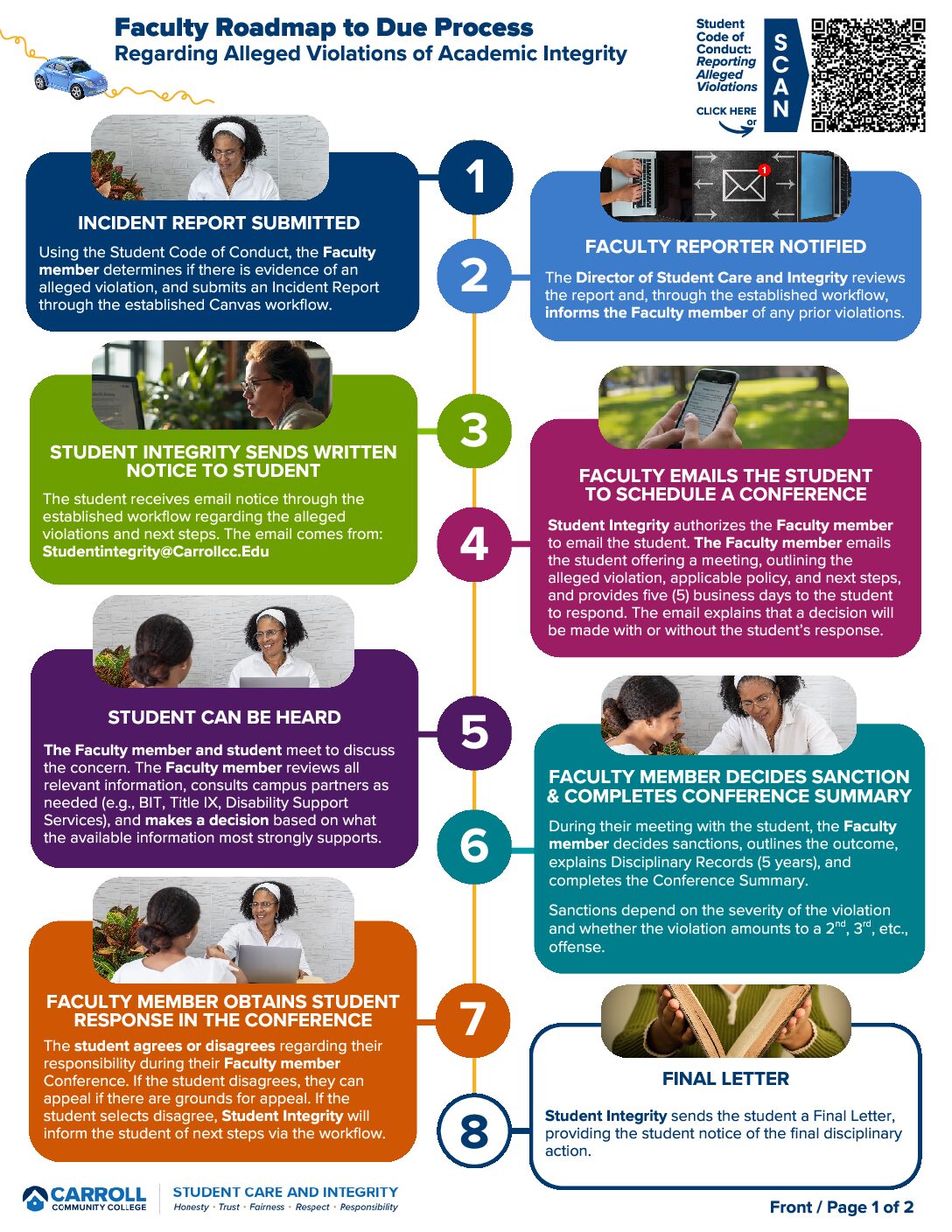
Faculty Roadmap to Due Process Regarding Alleged Violations of Academic Integrity
- Incident report submitted:
Using the Student Code of Conduct, the Faculty member determines if there is
evidence of an alleged violation and submits an Incident Report through the
established Canvas workflow. - Faculty reporter notified:
The Director of Student Care and Integrity reviews the report and, through the
established workflow, informs the Faculty member of any prior violations. - Student Integrity sends written notice to student:
The student receives email notice through the established workflow regarding
the alleged violations and next steps. The email comes from
StudentIntegrity@Carrollcc.edu. - Faculty emails the student to schedule a conference:
Student Integrity authorizes the Faculty member to email the student. The
Faculty member offers a meeting, outlines the alleged violation, applicable
policy, and next steps, and provides five (5) business days for the student to
respond. The email explains that a decision will be made with or without the
student’s response. - The student can be heard:
The Faculty member and student meet to discuss the concern. The Faculty member
reviews all relevant information, consults campus partners as needed
(e.g., BIT, Title IX, Disability Support Services), and makes a decision based
on what the available information most strongly supports. - Faculty member decides sanction and completes Conference Summary:
- During the meeting, the Faculty member decides sanctions, outlines the
outcome, explains Disciplinary Records (5 years), and completes the
Conference Summary. - Sanctions depend on the severity of the violation and whether the violation
amounts to a 2nd, 3rd, etc. offense.
- During the meeting, the Faculty member decides sanctions, outlines the
- Faculty member obtains student response:
The student agrees or disagrees regarding their responsibility during the
conference. If the student disagrees, they may appeal if there are grounds.
Student Integrity will inform the student of next steps via the workflow. - Final letter:
Student Integrity sends the student a Final Letter providing notice of the
final disciplinary action.
Pause, Pivot to Policy, Provide Due Process
Faculty members have a responsibility to uphold the Student Code of Conduct by
adjudicating alleged Academic Integrity violations. Per Association for Student
Conduct Administration (ASCA) guidelines, to adjudicate means to:
- Review relevant information, apply the Student Code of Conduct, and determine responsibility through a fair and impartial process that includes notice and an opportunity to be heard, on behalf of Carroll Community College. Adjudication is educational in nature (not punitive) and grounded in due process.
- Due process (click here) is the constitutional guarantee that public institutions of higher education must follow fair policies, procedures, and rules when addressing accusations related to a student.
Pause: Ground Your Actions in Policy. Due Process Is Your Best Protection Against Risk and Liability.
When a potential academic integrity concern arises, pause before acting. As the faculty adjudicator, you are serving on behalf of Carroll Community College to uphold students’ constitutional right to due process.
- Focus on observable evidence, not assumptions of intent
- Separate your instructional role from your adjudicative responsibility
- Avoid informal penalties or grading actions prior to completing the College process
Pivot to Policy: Apply the Student Code of Conduct.
- Use the Student Code of Conduct to identify the alleged violation
- Follow established College procedures for notice, meetings, documentation, and outcomes
- Refrain from implementing personal or alternative expectations or processes
Provide Due Process: Adjudicate Fairly and Consistently.
- Notice: Inform the student of the alleged violation and applicable policy
- Opportunity to Respond: Provide a meaningful chance for the student to share their perspective
- Fair Evaluation: Assess information objectively using the preponderance of evidence standard
- Educational Outcome: Assign proportional, developmental outcomes aligned with College guidance
Why This Matters at Carroll
- Upholds student rights and procedural fairness
- Protects faculty by anchoring decisions in the Student Code of Conduct
- Reinforces Carroll’s values of care, integrity, accountability, and learning
- Who is eligible for the Applied Cybersecurity Career Accelerator (ACCA)?
The ACCA is open to current Carroll Community College Cybersecurity A.A.S. students who maintain a minimum 3.25 GPA and meet participation requirements. - What will I do in the ACCA?
During the first few weeks, students will:- Meet with their dedicated faculty advisor to:
- Discuss educational and career goals
- Identify cybersecurity careers of interest
- Set goals, projects, and achievements for the semester
- Be matched with a cybersecurity mentor from the field
Throughout the semester, students will:
- Complete an advanced independent project
- Post project documentation to their professional portfolio
- Attend cybersecurity networking events
- Meet with their dedicated faculty advisor to:
- How long does the ACCA last?
Students who remain in good standing stay in the ACCA until they graduate from Carroll. ACCA alumni may continue to participate in most ACCA events after graduation. - Does it cost anything to participate in the ACCA?
The College does not charge students to participate in the ACCA, but there may be fees incurred for certifications, etc. - When can I apply?
- Eligible students may apply after completing CYBR-121 Networking Essentials.
- Applications are accepted during the first three weeks of each Fall & Spring semester.
- Applications are not accepted outside these periods.
- What are the application requirements, and how do I apply?
To apply, students must:- Maintain a minimum cumulative 3.25 GPA
- Complete the following free vendor trainings:
- Intro to Splunk
- Using Fields
- One training of the student’s choice from DeepLearning.AI
- Hold an active cybersecurity-related certification, or earn one within 75 days of entering the ACCA.
- Complete the Applied Cybersecurity Career Accelerator application.
- Sign the Applied Cybersecurity Career Accelerator Student Agreement.
- What is the time commitment?
Students should expect to spend about 4–6 hours per week outside of their regular coursework. The exact time commitment may vary depending on the student’s projects and goals. - Can I leave the Applied Cybersecurity Career Accelerator?
Yes. Students may leave the ACCA at any time. However, students who leave are not able to re-enter unless approved under special circumstances by the Program Director and Division Chair.
Mosaic (Random Sizes)


Mosaic (random sizes)





Mosaic Icons (images are exact minimum values)

2-Column Double Dimensions


3 Column Mixed

2 Column
Vestibulum placerat, turpis at fermentum aliquet, nunc ante varius sem, sit amet varius mi eros non leo. Aliquam dapibus efficitur dapibus. Etiam fermentum sodales leo, vel mattis nunc cursus eget. Vivamus sagittis lacus nibh, et cursus nulla sollicitudin eget. Praesent quis gravida nisl. Fusce et metus tellus. Curabitur arcu augue, porttitor rutrum ipsum sit amet, tristique tincidunt ligula. Donec finibus ex dolor, porttitor euismod felis pretium pharetra. Proin nisi felis, pellentesque sed bibendum non, placerat et nisi. Morbi scelerisque tellus ac justo interdum mollis. Nam ac varius urna. Donec elit nibh, ultricies quis nisl et, facilisis egestas lorem. Morbi id imperdiet sapien. Morbi non justo sem. Donec ut aliquet diam. Ut nisi ipsum, semper sed aliquet a, aliquet quis lectus.
Nullam tincidunt ipsum a est ullamcorper, sit amet interdum lorem interdum. Curabitur eget risus semper, fringilla elit id, feugiat tortor. Vestibulum elementum, neque eu facilisis dictum, nisi dolor hendrerit enim, sit amet molestie ligula justo ut nisi. Fusce mattis neque eget diam congue, ac vehicula dui feugiat. Quisque aliquam sapien a felis venenatis, non efficitur mauris vehicula. Mauris eget malesuada neque, et auctor risus. Donec ornare risus sit amet finibus convallis. Vestibulum dapibus vestibulum nisl, sed mattis sem bibendum id.