Student Assistance Information for Parents
Student Care
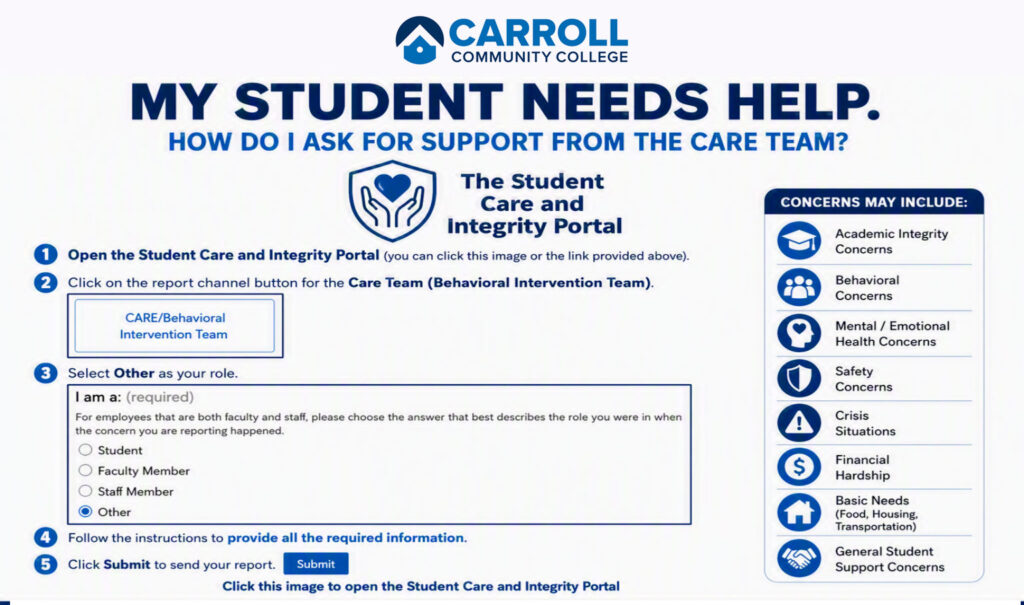
How can I report a concern about my student?
Parents, family members, and supporters who are concerned about a Carroll Community College student may submit a Student Concern & Incident Report Form to alert the College of concerns that may be affecting a student’s well-being, safety, or academic success.
For non-emergency concerns, please complete the Student Concern & Incident Report Form.
If there is an immediate threat to the student or others, call 911 and Campus Police at 410-386-8123.
Submitting a concern is a proactive way to connect students with appropriate support and resources. The Office of Student Care and Integrity works collaboratively with campus partners to assess concerns and coordinate outreach when appropriate.
Reports are reviewed by the Office of Student Care and Integrity, and outreach is typically initiated within 48 hours. Please note that due to the Family Educational Rights and Privacy Act (FERPA), the College may be limited in the information it can share regarding a student’s educational record without the student’s consent.
For questions or assistance, please contact Dr. DaVida Anderson, Director of Student Care and Integrity and Chair of the Behavioral Intervention Team, at danderson3@carrollcc.edu or 410-386-8217.
For use by parents, family members, and supporters who are concerned about a Carroll Community College student.
TimelyCare

Current Carroll credit students have free access to use our new Student Assistance Program, TimelyCare. TimelyCare is a service that offers virtual mental health and wellbeing services to students for free. Students have access to six free counseling sessions through Talk Now and the opportunity to self-maintain their wellbeing through the self-care journey and peer-to-peer community.
Talk Now
TalkNow allows students to visit from anywhere and get on-demand, 24/7 emotional support from a behavioral health provider to talk about concerns like:
- Anxiety
- Depression
- Substance use
- Stress
- Life transitions
- Academic challenges
- Relationship issues
Self-Care Journey
With TimelyCare’s Self-Care Journey, students have 24/7/365 access to short videos, interactive guides, and articles from experts on topics such as managing stress, relationships, and healthy eating.
Peer to Peer Community
Peer Community is easy to use. It’s a safe place for students to voice their thoughts, emotions, and feelings — wherever they are, whenever they need it.
Visit http://timelycare.com/carrollcc or download the app to your phone to access these services.
Integrity
Carroll Community College complies with the provisions of the Family Educational Rights and Privacy Act of 1974 (20 U.S.C.; 1232g) and any regulations which may be promulgated there under. Students and others who may wish specific information regarding their rights of access to Institutional educational records maintained in their names are referred to the Regulations section of the catalog.
The Registrar coordinates the inspection and review procedures for student educational records, which include:
- Academic files
- Admissions files
- Financial aid files
Students wishing to review their records must present:
- A written request to the Registrar listing the record(s) of interest
- Student I.D. card
- Photo identification
Access will be granted within at least 30 days from the date of the written request. See the College Regulations Section of the catalog for further information.
The Family Educational Rights and Privacy Act (FERPA), also known as the Buckley Amendment, protects the privacy of student records. In adherence to this law, Carroll faculty and staff does not disclose grades, performance or attendance with parents unless the student allows this. Students may obtain the form, Permission to Release Educational Records Information, in the Records Office (A112). Carroll encourages parents to discuss this important issue with their students.
For more information, see Student Privacy Through FERPA
Parents Stay Informed – Academic Dishonesty
Learn about the 5 Types of Academic Dishonesty.
Key Differences (with examples)
| Aspect | High School | College |
|---|---|---|
| Activity | School acts like a parent. Example: Principal calls parents about behavior. | Students are treated as adults. Example: Student meets with conduct officer, not parents. |
| Rules | State rules apply to all schools. Example: Dress code set by district. | Each college has its own rules. Example: University policy on academic honesty. |
| Parent Role | Parents are told about discipline. Example: Parent meeting before suspension. | Privacy law (FERPA) means college cannot share details without student consent. |
| Behavior Scope | Mostly covers what happens at school. Example: Fighting in class. | Covers campus and sometimes off-campus if it affects community. Example: Off-campus party causing harm. |
Due Process (What happens when rules are broken)
High School:
- Step 1: Investigation (teacher/principal checks facts)
- Step 2: Parent meeting
- Step 3: Discipline (detention or suspension)
- Step 4: Appeal to school board.
College:
- Step 1: Report filed
- Step 2: Investigation (student gets notice and can share their side)
- Step 3: Hearing (student can bring advisor)
- Step 4: Decision and sanction
- Step 5: Appeal within college.
Parent Tips
- A College Student is defined as any individual enrolled at the College, including dual-enrolled or underage students. All College Students must abide by the College’s policies and procedures regardless of age.
- Ask your student to share the college rules (FERPA means colleges can’t share without consent)
- Encourage your student to take responsibility for their actions.
- Understand that college processes take longer because they include formal hearings and appeals.
Did You Know? FERPA is a law that protects student privacy. Colleges cannot share conduct details with parents unless the student gives permission.